
What Does Headless Magento 2 Cost? A Realistic Breakdown
 By Sobhan Yaghoubi
What Does Headless Magento 2 Cost? A Realistic Breakdown
Ask three agencies what headless Magento 2 costs and you'll get three different answers — and, unusually, all three have published their numbers. Aureate Labs says $47,000 to $122,000. Onilab says $68,000 to $128,000. 2Hats Logic, scoping for established B2B merchants, says $120,000 to $350,000. All real, all defensible, and all measuring slightly different projects.
This guide reconciles those figures into a budget you can plan with. We'll cover what the build costs, what moves the price, and the license, hosting, and maintenance lines that never make the first quote. Then the ROI math — including our own client rebuild, which you can verify live. One thing has changed since every ranked cost article was written: Hyvä went free. We'll cover what that does to the decision too.
Key Takeaways - Published agency estimates put mid-market headless Magento 2 builds at $47,000–$128,000; complex B2B runs up to $350,000 (2Hats Logic, 2025). - Budget another 15–25% of the build cost every year for maintenance. - Hyvä Theme went free in November 2025 — rule it out before you sign a headless quote. - The ROI is measurable: our own rebuild lifted conversion 34%.
What does a headless Magento 2 build actually cost?
In 2026, the realistic published range for a headless Magento 2 build runs from $47,000 to $350,000, depending on who's measuring what. The floor comes from Aureate Labs' guide "Time and Cost to Build Headless Magento Store," which prices a full build at $47,000–$122,000 over four to seven months (Aureate Labs, 2024).
The other two published estimates measure narrower and wider scopes. Onilab's 2024 price breakdown covers converting an existing Luma store to a headless PWA: $68,000–$128,000, of which development alone is $43,000–$84,000, or 860–1,680 developer hours (Onilab, "Headless Commerce: Detailed Price Breakdown", 2024). 2Hats Logic's 2025 estimate targets established B2B businesses with heavier integration needs and lands at $120,000–$350,000 (2Hats Logic, "Cost Breakdown of a Headless Magento Implementation", 2025).
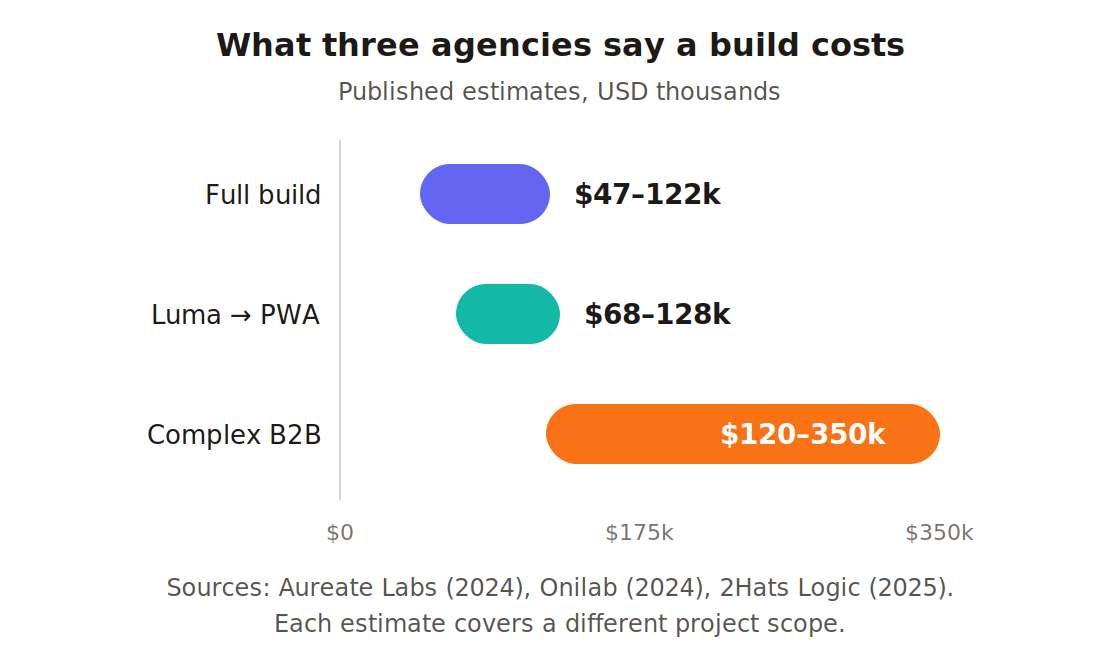
Sources: Aureate Labs (2024), Onilab (2024), 2Hats Logic (2025). Each estimate covers a different project scope.
Read together, the three ranges agree more than they appear to. Across three independent 2024–2025 agency estimates, a headless Magento 2 storefront costs $47,000–$128,000 at typical mid-market scope — rising to $120,000–$350,000 once B2B pricing, integrations, and custom checkout stack up. Netguru's 2026 agency-observed pricing draws the floor higher, at $75,000, because scope definitions differ (Netguru, 2026). Most single-storefront merchants we talk to land between $60,000 and $150,000.
What drives the price up or down?
In its April 2025 cost breakdown, 2Hats Logic maps where a headless budget actually goes: 35–40% backend and API work, 30–35% frontend build, 15–20% integrations, and 10–15% QA (2Hats Logic, 2025). Whatever your total, the levers that move it are the same five.

Catalog and pricing complexity. Ten thousand simple products cost less to make fast than five hundred configurables with tiered B2B pricing. Complexity lives in the rules, not the row count.
Checkout. Keeping Magento's native checkout is the single biggest saving available. A fully headless checkout is a project inside the project.
Integrations. Every ERP, PIM, search, and payment connection needs both backend and frontend work. Integration count is why the 2Hats Logic range starts where the Aureate Labs range ends.
Design maturity. In their 2024 guides, Onilab and Aureate Labs both price from-scratch UX and UI work at $16,000–$30,000 before a single component is built (Onilab; Aureate Labs). Arriving with a design system cuts that sharply.
Team location and seniority. The same build priced in Boston and Bucharest can differ by 2x. More on that lever below, because it's the one trending in your favor.
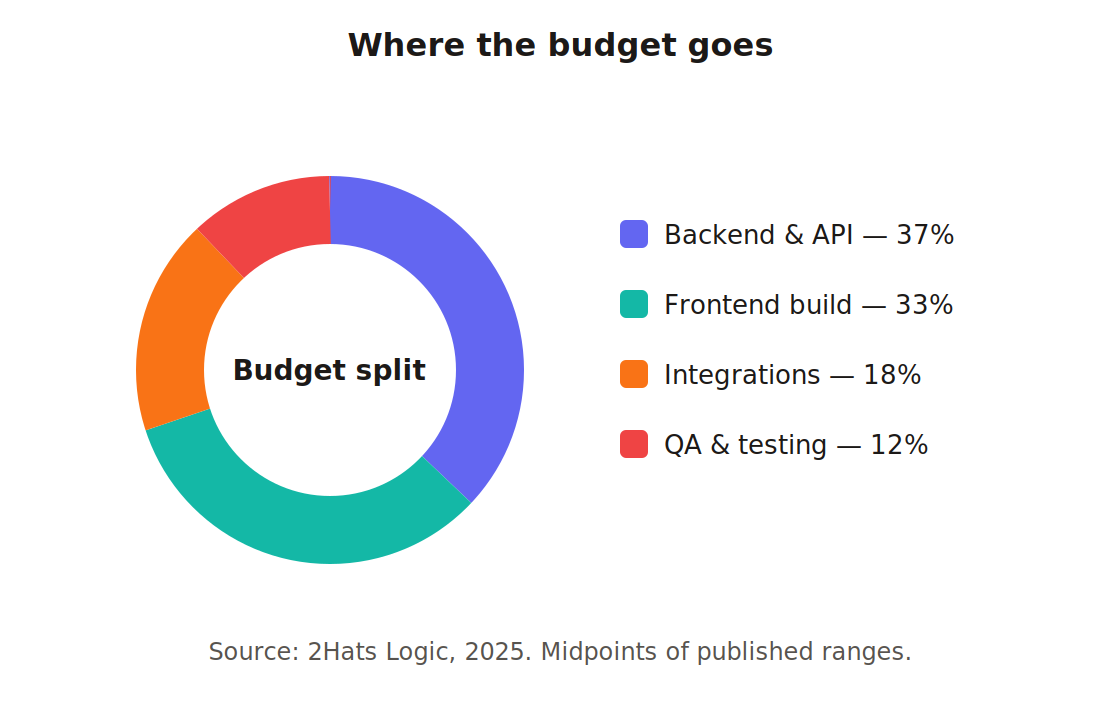
Source: 2Hats Logic, 2025. Midpoints of published ranges.
What we've seen first-hand: budgets rarely blow up on storefront pages. They blow up in month three, when an extension that renders in the frontend turns out to need a full rebuild. Or when integration number five surfaces after the contract is signed. It's why our headless Magento 2 development scoping starts with an extension and integration audit, not a homepage mockup.
The costs that never make the first quote
Running a headless storefront costs 15–25% of the initial implementation price every year, according to 2Hats Logic's 2025 analysis (2Hats Logic, 2025). On a $120,000 build, that's $18,000–$30,000 annually before you add a single feature. Three cost lines hide behind most headless quotes: the platform license, the second infrastructure bill, and maintenance.
Start with the license, because it's the most misunderstood. Headless does not require Adobe Commerce. Magento Open Source is a $0 license and exposes the same GraphQL APIs a headless frontend consumes (Adobe, 2026). Adobe Commerce is priced by rate card against your gross merchandise value — Adobe itself only quotes custom pricing, but the widely reported figures look like this (Elogic, "Magento / Adobe Commerce Pricing 2026", updated June 2026):
Annual GMV | Adobe Commerce (on-premise) | Adobe Commerce (cloud) |
|---|---|---|
Under $1M | $22,000/yr | $40,000/yr |
$1M–$5M | $32,000/yr | $55,000/yr |
$5M–$10M | $49,000/yr | $80,000/yr |
$10M–$25M | $75,000/yr | $120,000/yr |
$25M+ | $125,000/yr | $190,000/yr |
Pay that for B2B suites, staging environments, and Adobe's cloud — not for headless. Plenty of fast headless storefronts run on the $0 license.
The second line is infrastructure, because headless means two systems in production. The same 2025 analysis prices the stack at $800–$5,000 a month for hosting, plus $200–$1,000 for CDN and $300–$1,500 for API management (2Hats Logic, 2025). The frontend itself is the cheap part. As of July 2026, Vercel Pro lists at $20 per user monthly and Netlify Pro at $20 monthly (Vercel; Netlify), though bandwidth bills scale with real traffic.
The third is people. Two codebases need updates, security patches, and monitoring, which is where that 15–25% annual figure comes from. Budget it up front, or price a Magento 2 support retainer that covers both halves. A quote that's silent about month thirteen isn't cheaper. It's just quieter.
Is headless Magento worth it?
In 2020, Deloitte and Google measured 37 brand sites across more than 30 million sessions (Deloitte, "Milliseconds Make Millions", 2020). A 0.1-second mobile speed improvement lifted retail conversions 8.4% and average order values 9.2%. Speed is the mechanism through which a headless build pays itself back.
The tax runs the other way too. Back in 2017, Google's benchmark research found 53% of mobile visitors abandon a page that takes longer than three seconds to load (Google, "New Industry Benchmarks for Mobile Page Speed", 2017). A slow Luma frontend charges it on every session.
The composable-commerce ROI research points the same way, but read the sample before you quote it. In January 2025, the MACH Alliance's survey of 561 enterprise IT leaders found nine in ten saying their composable investments met or exceeded ROI expectations (MACH Alliance, 2025 Global Annual Research Report, 2025). Those respondents work at companies with $500M+ turnover. Mid-market math is less forgiving — the same rebuild is a bigger share of your revenue — which is why the cost discipline in this guide matters more below the enterprise line.

Our own data point is first-hand Vesta client work, and it's public. Royal Creation (royal-creations.ch), a Swiss made-to-order rug atelier, moved from Luma to a headless Next.js storefront on its existing Magento 2 backend. Lighthouse went from 45 to 96, load time from 8.2 to 1.4 seconds, and conversion rose 34%. The full case study names the store, so you can test it live today, and the technical rebuild is documented here. One store, one vertical — not a guarantee. But it's verifiable, which is more than most ROI slides can say.
Put those numbers together and payback becomes arithmetic. A store doing $2 million a year that captures even half of Royal Creation's 34% conversion lift adds roughly $340,000 in annual revenue — against a $100,000 build. Onilab's own model arrives at an 8–10 month payback on similar assumptions (Onilab, 2024), though treat that as a vendor model, not a measurement. The candid version: if your traffic is real and your storefront is slow, the ROI case closes. If either isn't true, it doesn't.
So when does the math not close?
Hyvä is free now — and it changes the decision
Hyvä announced in November 2025 that its theme was going open source and free, with more than 6,000 live stores at the time, including Nestlé and Volkswagen brands (Hyvä, "It's time: we're making Hyvä Theme Open Source and Free", 2025). Paid products remain — Hyvä Checkout at €1,000, Hyvä Commerce at €3,000 a year — but the license objection to the "fast Magento without headless" path just disappeared. Every ranked cost article predates that announcement. Your decision shouldn't.
Hyvä replaces Luma's aging JavaScript with a lean Alpine.js and Tailwind stack. You stay monolithic, keep your PHP team's workflow, and can hit Google's 2.5-second LCP bar (Google, 2026) for a fraction of a headless budget.
So the real 2026 decision isn't "headless or nothing." It's a three-way split, and cost is only one axis:
Fix Luma first if you haven't audited yet. Targeted Magento 2 performance optimization can buy back seconds without replacing anything.
Choose Hyvä when the catalog is conventional, the team is PHP-centric, and the budget sits under roughly $50,000. Since November 2025, the theme license costs nothing.
Choose headless when the storefront is the strategy: image-heavy exploratory catalogs, app-like UX, multi-storefront rollouts, or design ambitions a theme can't reach. That's the profile where Royal Creation's 34% lived.
Recommending a $0 theme to the merchants it fits is what keeps the six-figure recommendation credible for the merchants it doesn't. Any agency that skips this fork is selling its default, not scoping your store.
How do you keep a headless budget under control?
Accelerance's November 2025 survey of roughly 60 development firms found senior offshore rates falling in every region, down 4–8% year over year (Accelerance, "2026 Outsourcing Rates", 2025). The 2026 bands: Central and Eastern Europe at $64–76 an hour, Latin America $60–75, Asia $31–41. Team composition is the biggest single lever on your total, and it's trending in your favor.
Region | Senior developer rate (2026) |
|---|---|
US / Western Europe | $100–160/hr |
Central & Eastern Europe | $64–76/hr |
Latin America | $60–75/hr |
Asia | $31–41/hr |
US/Western Europe band per Accelerance's 2025 Global Software Outsourcing Rates & Trends Guide; other regions per its November 2025 update.
Four more levers keep the number honest:
Phase the rollout. Ship catalog and product pages headless first and keep Magento's native checkout initially. You bank the speed win where revenue lives before funding the hardest module.
Audit before you sign. Every extension that renders in the frontend and every integration should be on a list, with an owner and a price, before the contract exists. Surprises are the real budget killer, not rates.
Choose a stack with a future. Adobe still documents PWA Studio with no deprecation notice, but its docs now describe migration paths toward Commerce Storefront on Edge Delivery Services, and call its drop-in components "framework agnostic" (Adobe developer documentation, 2026). Betting a six-figure build on a toolkit the vendor is steering away from is a cost decision, not just a technical one. A custom Next.js storefront keeps the frontend yours regardless of Adobe's roadmap.
Write the performance budget into the contract. A headless build that ships slow is the most expensive outcome of all. Our guide to choosing a headless Magento 2 agency covers the exact clauses and the vetting checklist.
Frequently Asked Questions
How much does headless Magento 2 cost for a small store?
The published floor sits around $47,000 in Aureate Labs' 2024 estimate (Aureate Labs). Quotes far below that usually buy a client-rendered template with your logo on it. If your budget stops short of the floor, a free Hyvä theme or targeted performance work is the smarter spend.
Do I need Adobe Commerce to go headless?
No. Magento Open Source carries a $0 license and exposes the same GraphQL APIs a headless frontend needs. Adobe Commerce's widely reported 2026 rate card adds roughly $22,000–$190,000 a year (Elogic) for B2B suites and cloud hosting — pay it for those features, not for headless.
How much does headless Magento maintenance cost per year?
Plan on 15–25% of the initial implementation cost annually, per 2Hats Logic's 2025 analysis (2Hats Logic). That covers updates across two codebases plus the infrastructure bill: $800–$5,000 monthly hosting, with CDN and API management on top. A $100,000 build implies $15,000–$25,000 a year.
How long does a headless Magento 2 build take?
Four to seven months for a typical store, per Aureate Labs' 2024 guide (Aureate Labs); Onilab's 2024 breakdown sizes comparable work at 860–1,680 development hours (Onilab). Catalog complexity, integration count, and the checkout choice decide where you land. A weeks-long promise made before any audit is a red flag.
Is headless Magento worth it for a mid-market store?
When traffic is real and the storefront is slow, yes — measurably. Our Royal Creation rebuild lifted conversion 34% while Lighthouse went from 45 to 96, and Deloitte's 2020 research ties each 0.1s of mobile speed to +8.4% retail conversions (Deloitte). With Hyvä free since November 2025, just verify headless beats it for your catalog first.
The realistic bottom line
Headless Magento 2 pricing stops being murky once you stack every line item in one place:
Build: $47,000–$128,000 for most mid-market scopes; $120,000–$350,000 for complex B2B (three independent agency estimates, 2024–2025).
Run: 15–25% of the build cost per year, plus an $800–$5,000 monthly infrastructure line.
License: $0 on Magento Open Source. Adobe Commerce's $22,000–$190,000 rate card buys enterprise features, not headless.
Decide: rule out free Hyvä and plain performance tuning first. Headless earns its price when the storefront is the strategy.
The cheapest step is knowing which path fits. Get a free performance audit and we'll baseline your store's Core Web Vitals. Then you get a scoped number for tuning, Hyvä, or headless — and if the cheaper path fits your store, that's the one we'll recommend.
Sources
Aureate Labs, "Time and Cost to Build Headless Magento Store," retrieved 2026-07-02, https://aureatelabs.com/blog/build-headless-magento-store/
Onilab, "Headless Commerce: Detailed Price Breakdown," retrieved 2026-07-02, https://onilab.com/blog/headless-commerce-pricing
2Hats Logic, "Cost Breakdown of a Headless Magento Implementation," retrieved 2026-07-02, https://www.2hatslogic.com/blog/magento/headless-cost-breakdown/
Elogic, "Magento / Adobe Commerce Pricing 2026," retrieved 2026-07-02, https://elogic.co/blog/magento-pricing-explained/
Netguru, "The Real Price of Headless Commerce: Breaking Down Hidden Costs," retrieved 2026-07-02, https://www.netguru.com/blog/the-real-price-of-headless-commerce
Google, "Core Web Vitals report" (Search Console Help), retrieved 2026-07-02, https://support.google.com/webmasters/answer/9205520
Adobe, "Adobe Commerce pricing," retrieved 2026-07-02, https://business.adobe.com/products/magento/pricing.html
Accelerance, "2026 Outsourcing Rates: Global Costs Are Trending Down," retrieved 2026-07-02, https://www.accelerance.com/blog/2026-outsourcing-rate-trends-asia-europe-latam
Accelerance, "2025 Global Software Outsourcing Rates & Trends Guide," retrieved 2026-07-02, https://www.accelerance.com/2025-global-software-outsourcing-rates-and-trends-guide
MACH Alliance, "2025 Global Annual Research Report" (press release), retrieved 2026-07-02, https://machalliance.org/newsroom/press-release-2025-global-annual-research-report
Deloitte with Google, "Milliseconds Make Millions," retrieved 2026-07-02, https://www.deloitte.com/ie/en/services/consulting/research/milliseconds-make-millions.html
Google, "New Industry Benchmarks for Mobile Page Speed" (Think with Google), retrieved 2026-07-02, https://business.google.com/ca-en/think/marketing-strategies/mobile-page-speed-new-industry-benchmarks/
Hyvä, "It's time: we're making Hyvä Theme Open Source and Free," retrieved 2026-07-02, https://www.hyva.io/blog/news/hyva-is-free-open-source.html
Adobe, PWA Studio developer documentation, retrieved 2026-07-02, https://developer.adobe.com/commerce/pwa-studio/
Vercel, "Pricing," retrieved 2026-07-02, https://vercel.com/pricing
Netlify, "Pricing," retrieved 2026-07-02, https://www.netlify.com/pricing/
Vesta Web Agency project data, Royal Creation (royal-creations.ch)
Published at Blog2026-07-02 · Vesta Web Agency

Ready to Transform Your Store?
Get a free performance audit from our certified Magento 2 team.
Get a Free QuoteMore Articles

Mon Jun 29 2026 · 11
Magento 2 Lighthouse Score: 45 to 96 (A Real Case Study)

Sat Jun 27 2026 · 6
Headless Magento 2 Explained: What Decoupling the Frontend Actually Does

Sat Jun 27 2026 · 7
The Pre-BFCM Performance Checklist for Magento 2 Stores

Thu May 28 2026 · 8